




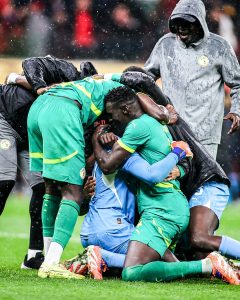
Finals are never ordinary games. They exist in a space where emotion outweighs logic, and moments carry more weight than minutes. The AFCON 2025 final, played on the night of January 18, 2026, in Rabat, was not merely a contest between Morocco and Senegal, it was a slow-burning drama that unfolded layer by layer, testing patience, nerve, and belief until only one team was left standing.
Long before kickoff at the Prince Moulay Abdellah Stadium, the sense of occasion was unmistakable. Rabat pulsed with anticipation. Morocco, hosts and dreamers, carried the hopes of a nation eager to end a decades-long wait for continental glory. Senegal, hardened by recent success and setbacks alike, arrived with the quiet confidence of a side that understands what it takes to win when everything is on the line.
From the opening whistle, it was clear this final would not be defined by chaos, but by control. Morocco dominated early possession, moving the ball with patience and intent, while Senegal settled into a compact, disciplined shape. The Lions of Teranga showed no interest in being drawn into an emotional battle as they were all about managing the game, not chase it.
The first half unfolded cautiously, almost methodically. Chances were limited, but the tension was constant. Senegal looked most threatening on the break, with Iliman Ndaiye’s movement asking questions of Morocco’s back line. One such moment forced Yassine Bounou into sharp action, the goalkeeper reacting instinctively to keep the score level. At the other end, Morocco searched for openings through Ayoub El Kaabi, but Senegal’s defensive structure rarely allowed him the space he thrives on.
Both goalkeepers Bounou and Edouard Mendy embodied calm. Every catch, every distribution felt deliberate, as if even they understood that a single mistake could define the night. The halftime whistle arrived with the scoreboard untouched, yet the match felt heavy, pregnant with something inevitable.
The second half raised the temperature.
Morocco began to press with more urgency, encouraged by the relentless energy of the home crowd. Their full backs pushed higher, midfielders took greater risks, and the tempo quickened. Senegal responded with composure rather than panic, slowing the game whenever possible, breaking Morocco’s rhythm with clever fouls and intelligent positioning.
As minutes ticked away, the final began to feel like it was drifting toward penalties — that cruel lottery that spares no one. Every tackle was greeted with a roar, every clearance with relief. Players grew visibly cautious, aware that one mistimed challenge could tip the balance irreversibly.
And then, in the dying moments of stoppage time, everything exploded.
Deep into added time, a challenge involving Brahim Diaz inside the penalty area brought the referee’s whistle. The decision pointed to the spot. VAR intervened, reviewed, and confirmed it. Rabat erupted but not in unison. Celebration clashed with disbelief. Senegal’s players reacted furiously, surrounding officials, gesturing in protest, their frustration spilling over.
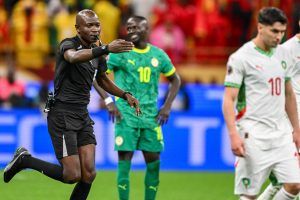
What followed was one of the most chaotic scenes ever witnessed in an AFCON final. Senegal’s camp momentarily walked away from the contest, refusing to accept the decision. The match ground to a halt. Officials scrambled, captains intervened, and tension hung thick in the air. It was ugly, emotional, raw, the kind of moment that exposes how much these games truly mean.
Eventually, Senegal returned. The penalty stood.
The responsibility fell to Brahim Diaz, Morocco’s creative heartbeat and the leading goal scorer of the tournament. The stadium held its breath. This was the moment, the kick that could crown hosts champions or drag the final into chaos. Díaz chose audacity. He attempted a Panenka.

But finals punish hesitation.
The chip lacked conviction. Edouard Mendy, reading the moment perfectly, stood his ground and gathered the ball calmly. In a heartbeat, Morocco’s joy turned to disbelief. Senegal had survived the storm.
The referee blew for extra time, but psychologically, the match had already shifted as Senegal emerged renewed, energized by escape. Morocco, by contrast, carried the invisible weight of a chance missed. Just four minutes into extra time, the defining moment arrived. Senegal worked the ball forward with purpose through Sadio Mane who pushed forward, attempting a backheel to Idris Gana Gueye who passed forward refusing to retreat into survival mode. When Pape Gueye found space outside the box, he drove forward with intent, brushing aside pressure before unleashing a thunderous strike. The ball flew past Bounou and into the top corner.
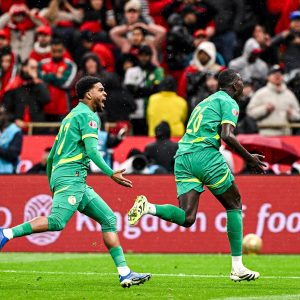
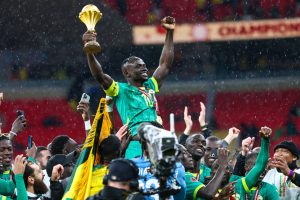
For a moment, the stadium fell silent stunned, hollowed by the sudden reversal of fortune. Then came the eruption from the Senegalese bench, players sprinting, arms raised, disbelief melting into pure joy. It was a goal worthy of a final, a strike forged from courage and timing.
What followed was not beautiful football, but it was championship football.
Morocco threw everything forward in desperation. Senegal defended with bodies, hearts, and belief. Every block felt monumental, every clearance celebrated like a goal. Time slowed. Seconds stretched. The crowd urged, pleaded, prayed, but Senegal refused to bend.
When the final whistle finally pierced the Rabat night, the truth was sealed; Senegal became African Champions for the second time denying the host nation a close chance to win their first title in fifty years.
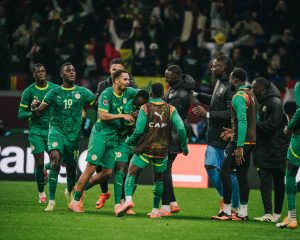
This victory was not built on dominance or flair alone. It was forged in resilience, in discipline, in surviving controversy and responding with clarity when it mattered most. Senegal had stared into the abyss and stepped back stronger.
For Morocco, the pain will linger. A home final lost, a penalty missed, a dream delayed once more. For Senegal, this night will live forever, a reminder that champions are not defined by how they play when things go smoothly, but by how they respond when everything threatens to fall apart.
AFCON, in all its drama and unpredictability, delivered a final that will be remembered not just for the result, but for the journey it took to get there. This was African football at its most intense, its most emotional, its most unforgettable.