

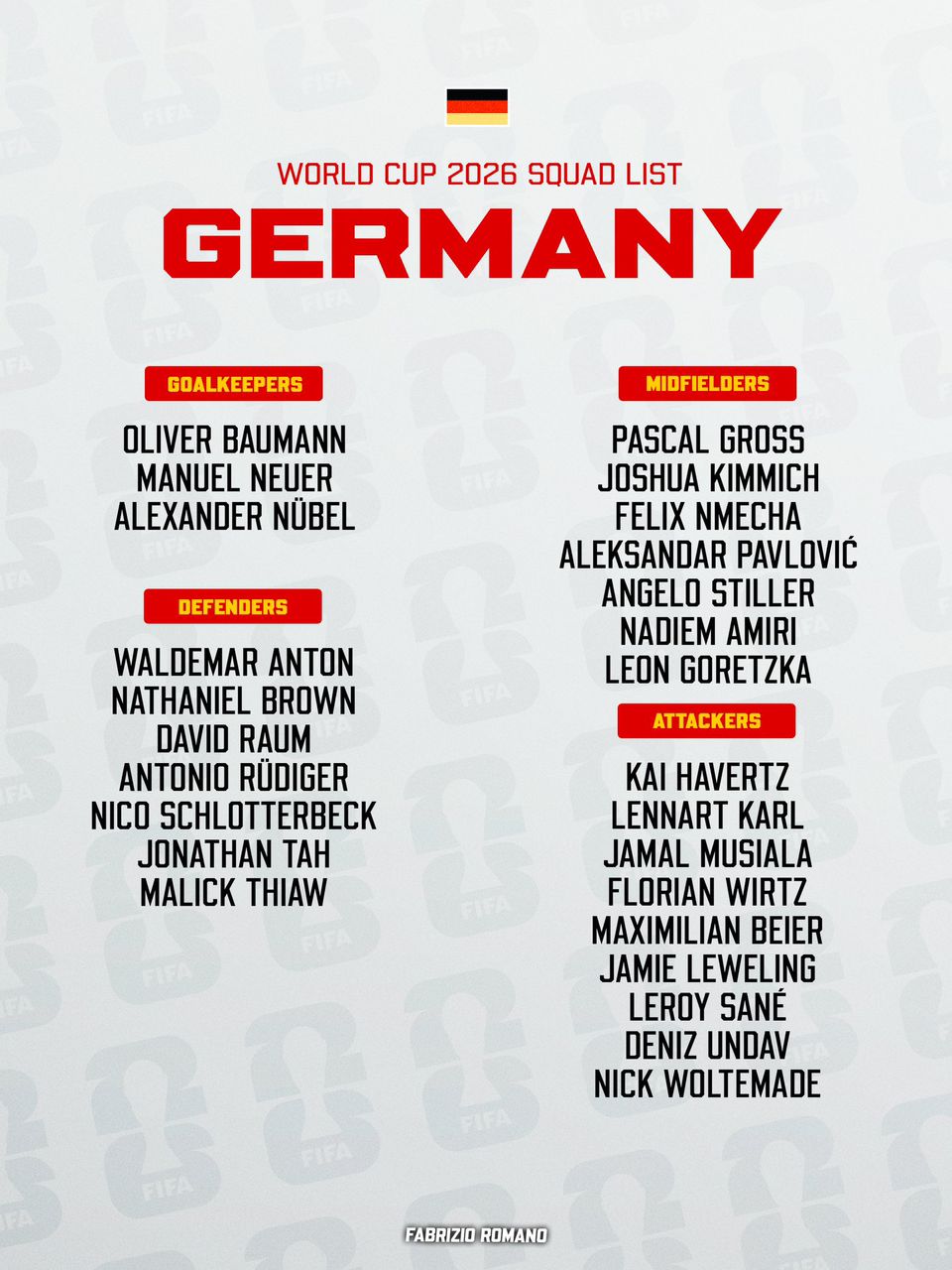
Germany have officially unveiled their squad for the 2026 FIFA World Cup, and while the selections confirm the arrival of an exciting new generation, the biggest reactions across the football world have centered on the shock names left out.
Among the most notable omissions are Marc-André ter Stegen, Robert Andrich, Noah Atubolu, Jan-Niklas Beste, Aurèle Amenda, Niclas Füllkrug, Karim Adeyemi, and Kevin Schade — bold decisions that immediately underline Germany’s aggressive shift toward a younger and more tactically dynamic squad ahead of the tournament.
The omissions of Ter Stegen and Füllkrug, in particular, have already generated massive debate among supporters and analysts. Ter Stegen’s absence is especially surprising given his status as one of the most experienced goalkeepers available to Germany, while Karim Adeyemi’s omission removes one of the country’s fastest and most explosive attacking profiles.
Yet despite those controversial decisions, Germany’s final squad still carries enormous quality and perhaps, for the first time in years, genuine balance.
This feels like the beginning of a completely new chapter for German football.
In goal, Manuel Neuer once again leads the squad and is expected to start what could become the final World Cup campaign of his legendary international career. Even at this stage of his career, Neuer’s leadership, composure, and experience remain invaluable for a Germany side attempting to return to the summit of international football.
Oliver Baumann and Alexander Nübel provide support behind the veteran goalkeeper, with Germany clearly prioritizing continuity and trust in experience despite growing competition from younger options like Noah Atubolu, who was ultimately left out.
Defensively, Germany have assembled a physically aggressive and tactically flexible unit led by Antonio Rüdiger.
The Real Madrid defender remains the emotional leader of the backline and one of the team’s most important figures heading into the tournament. Alongside him, Nico Schlotterbeck and Jonathan Tah provide aerial strength, composure, and defensive presence.
Waldemar Anton’s inclusion continues his rise as one of Germany’s most dependable defenders, while David Raum and Nathaniel Brown offer pace and attacking width from wide areas.
The squad also reflects Germany’s growing emphasis on positional versatility, with several players capable of operating across multiple defensive structures depending on tactical demands.
In midfield, Germany may possess one of the most technically balanced units in the competition.
Joshua Kimmich once again stands at the center of the team’s identity. His leadership, tactical intelligence, and passing range remain absolutely crucial if Germany hope to challenge for the World Cup.
Alongside him, Leon Goretzka brings physicality and experience, while Pascal Groß offers calmness and control in possession. Aleksandar Pavlović’s inclusion further highlights Germany’s commitment to youth development, with the young midfielder increasingly viewed as one of the future leaders of the national team.
Felix Nmecha, Angelo Stiller, and Nadiem Amiri complete a midfield group capable of combining technical quality with defensive discipline.
But the true excitement surrounding this Germany squad lies in attack.
Jamal Musiala and Florian Wirtz are now officially the faces of Germany’s new era.
For years, German football searched for the next generation capable of restoring creativity, flair, and unpredictability to the national team. In Musiala and Wirtz, they may finally have found two players capable of leading Germany back to the elite level of world football.
Musiala’s dribbling ability and intelligence between the lines make him one of the most gifted young players in the sport, while Wirtz’s creativity and composure have turned him into one of Europe’s most complete attacking midfielders.
Kai Havertz adds versatility and experience across the frontline, while Leroy Sané’s pace and directness remain major weapons in transition.
Maximilian Beier, Deniz Undav, Jamie Leweling, and Niclas Woltemade complete an attacking group filled with movement, technical quality, and tactical flexibility.
Still, the squad announcement ultimately sends one clear message:
Germany are prioritizing evolution over sentiment.
The omissions of experienced figures and high-profile attacking talents demonstrate a coaching staff willing to make difficult decisions in pursuit of building a younger, more fluid, and more tactically modern team.
After years of disappointing tournament exits and growing pressure surrounding the national team’s identity, Germany now appear determined to reset the culture entirely.
And with Musiala and Wirtz leading a fearless new generation, there is growing belief that German football may finally be ready to rise again on the