
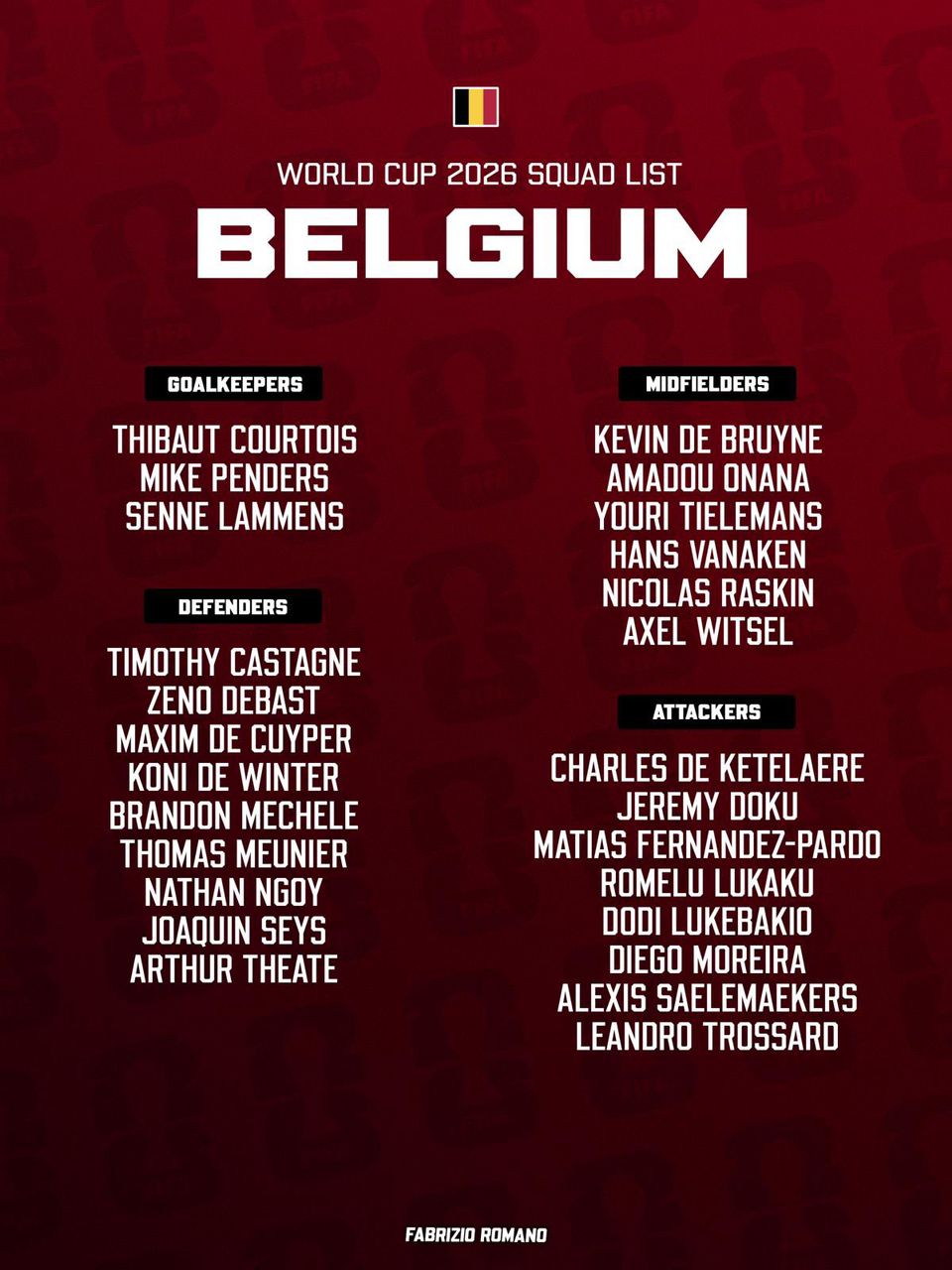
Belgium have officially unveiled their final squad for the 2026 FIFA World Cup, and the announcement has already sparked major debate across European football.
While familiar names such as Kevin De Bruyne, Romelu Lukaku, and Thibaut Courtois remain at the center of the squad, the biggest talking points from Rudi Garcia’s selection have been the shock omissions, the arrival of younger talents, and the growing sense that this could be the final World Cup appearance for Belgium’s golden generation.
The Red Devils head into the tournament carrying enormous pressure after years of falling short on the international stage despite possessing one of the most talented generations in football history. From semifinal heartbreak in 2018 to disappointing exits in recent major tournaments, Belgium now face what many believe could be their last realistic opportunity to compete for football’s biggest prize with this core of players.
And this squad selection reflects exactly that tension between legacy and transition.
In goal, Thibaut Courtois returns as Belgium’s undisputed number one after periods of uncertainty surrounding injuries and his international future. Even after missing significant football over the last two seasons, Courtois remains one of the best goalkeepers in world football and arguably Belgium’s most important player heading into the tournament.
Alongside him are Mike Penders and Senne Lammens, two younger goalkeepers viewed as part of the country’s long-term future.
Defensively, Belgium appear to have embraced a new era.
The days of Vincent Kompany, Toby Alderweireld, and Jan Vertonghen dominating the backline are now firmly over, with Rudi Garcia placing his faith in a younger and more athletic defensive unit led by Zeno Debast, Arthur Theate, Koni De Winter, and Maxim De Cuyper.
Timothy Castagne and Thomas Meunier provide much-needed experience, while Brandon Mechele and Nathan Ngoy add depth and physicality. Joaquin Seys’ inclusion also highlights Belgium’s willingness to trust emerging talents despite the enormous pressure of a World Cup tournament.
However, midfield remains the emotional heartbeat of this Belgian side.
Kevin De Bruyne once again headlines the squad and will almost certainly captain the Red Devils into what could be his final World Cup campaign. The veteran playmaker remains Belgium’s creative engine and one of the greatest players the country has ever produced.
Alongside De Bruyne, Belgium have selected Amadou Onana, Youri Tielemans, Axel Witsel, Hans Vanaken, and Nicolas Raskin — a blend of experience, composure, and physicality that gives Garcia several tactical options.
Yet the attack is where Belgium’s squad selection has caused the biggest reaction.
Romelu Lukaku has been included despite concerns surrounding injuries and match fitness. The striker remains Belgium’s all-time leading goalscorer, and Garcia clearly believes his leadership and experience still make him indispensable to the national team setup.
Jeremy Doku is expected to be one of Belgium’s key attacking weapons after establishing himself as one of the most dangerous dribblers in European football. His pace and unpredictability could become crucial if Belgium hope to challenge the tournament favorites.
Leandro Trossard, Charles De Ketelaere, Dodi Lukebakio, Alexis Saelemaekers, and Diego Moreira complete a technically gifted and versatile attacking group capable of playing in multiple systems.
However, one of the most talked-about inclusions is Matias Fernandez-Pardo.
The highly rated young attacker recently committed his international future to Belgium despite interest from Spain, and his inclusion signals the federation’s determination to build the next generation around fearless young talent.
Still, the headlines have arguably been dominated more by who was left out than who made the squad.
The omission of Romeo Lavia has shocked many supporters given the midfielder’s enormous potential, while Loïs Openda’s absence has generated even greater controversy considering his recent form and goalscoring ability. Young talents Arthur Vermeeren and Malick Fofana were also left out in decisions that have already divided opinion among fans and analysts.
Those omissions underline the ruthless nature of Garcia’s approach heading into the World Cup. Rather than selecting players purely for future development, Belgium’s coach appears determined to prioritize experience, tactical balance, and reliability for what could become a defining tournament for the nation.
There is now a growing feeling around Belgian football that this World Cup represents more than just another tournament.
It represents the closing chapter of a generation that once promised to dominate international football.
For years, Belgium were viewed as football’s “nearly team” — blessed with elite talent but unable to convert potential into silverware. Now, with De Bruyne, Lukaku, Courtois, and Witsel potentially entering their final major international competition together, the stakes feel even higher.
At the same time, the emergence of players like Doku, Debast, Fernandez-Pardo, and De Ketelaere suggests Belgium may already be preparing for life beyond the golden generation.
Whether this squad can finally deliver the success Belgian football has chased for over a decade remains uncertain.
But one thing is clear: the 2026 FIFA World Cup could define the legacy of an entire footballing era for the Red Devils.