


Thomas Tuchel has officially unveiled England’s squad for the 2026 FIFA World Cup — and the selections have immediately sent shockwaves across world football.
In one of the boldest England squad announcements in recent memory, Tuchel has left out several of the country’s biggest stars, including Harry Maguire, Luke Shaw, Trent Alexander-Arnold, Phil Foden, Cole Palmer, Morgan Gibbs-White, Jarrod Bowen, Levi Colwill, Lewis Hall, and Danny Welbeck.
The decisions instantly sparked massive reactions across social media, with supporters and pundits debating whether Tuchel’s ruthless approach is a sign of tactical genius or an enormous gamble ahead of football’s biggest tournament.
But beyond the controversy, the squad reveals something much deeper about Tuchel’s vision for England.
This is not a team selected based on reputation, popularity, or past performances.
This is a squad built almost entirely around physical intensity, tactical flexibility, athleticism, and current form.
And nowhere is that more obvious than in the names left behind.
Cole Palmer’s omission may be the most emotionally debated decision of them all. At his best, Palmer is one of England’s most creative and unpredictable attacking players. However, injuries repeatedly interrupted his season, preventing him from maintaining rhythm and consistency. Even after returning late in the campaign, he struggled to rediscover the fearless sharpness that made him one of the Premier League’s most dangerous players.
Phil Foden’s absence is equally stunning.
For years, Foden was viewed as one of the central pillars of England’s future. But this season never truly clicked for him. Injuries, inconsistency, and limited continuity at club level affected his rhythm throughout the campaign, and Tuchel has ultimately decided not to take the risk on a player who has not fully looked himself for months.
Then there is Trent Alexander-Arnold.
One of the most technically gifted footballers England have produced has been sacrificed in favor of more athletic and defensively aggressive full-back profiles like Tino Livramento and Jed Spence. It is a decision that perfectly reflects Tuchel’s tactical priorities.
The England manager appears determined to build a side capable of pressing aggressively, defending large spaces, and surviving high-intensity knockout football. While Trent’s passing ability remains elite, Tuchel clearly believes other profiles fit his defensive structure more naturally.
Harry Maguire’s omission marks the end of a major era for England.
Despite years of criticism at club level, Maguire consistently delivered for the national team in tournament football. His leadership, aerial dominance, and threat from set-pieces made him one of Gareth Southgate’s most trusted players.
But Tuchel’s England looks very different.
The German coach has prioritized quicker defenders, greater mobility, and players capable of operating in aggressive defensive lines. Ezri Konsa, Marc Guéhi, Jarell Quansah, and Dan Burn all reflect the physical and tactical identity Tuchel appears determined to establish.
Levi Colwill and Luke Shaw’s absences are also heavily connected to fitness concerns after both defenders endured injury-disrupted campaigns.
Meanwhile, Morgan Gibbs-White’s omission may be one of the harshest decisions based purely on form. Statistically, Gibbs-White produced one of the strongest creative seasons among England’s attacking midfielders. But England’s depth in those areas remains so overwhelming that even elite domestic performances were ultimately not enough.
Jarrod Bowen, Lewis Hall, Alex Scott, and Danny Welbeck also miss out despite impressive moments throughout the season.
Yet despite all the controversy, Tuchel’s final squad still carries enormous quality and balance.
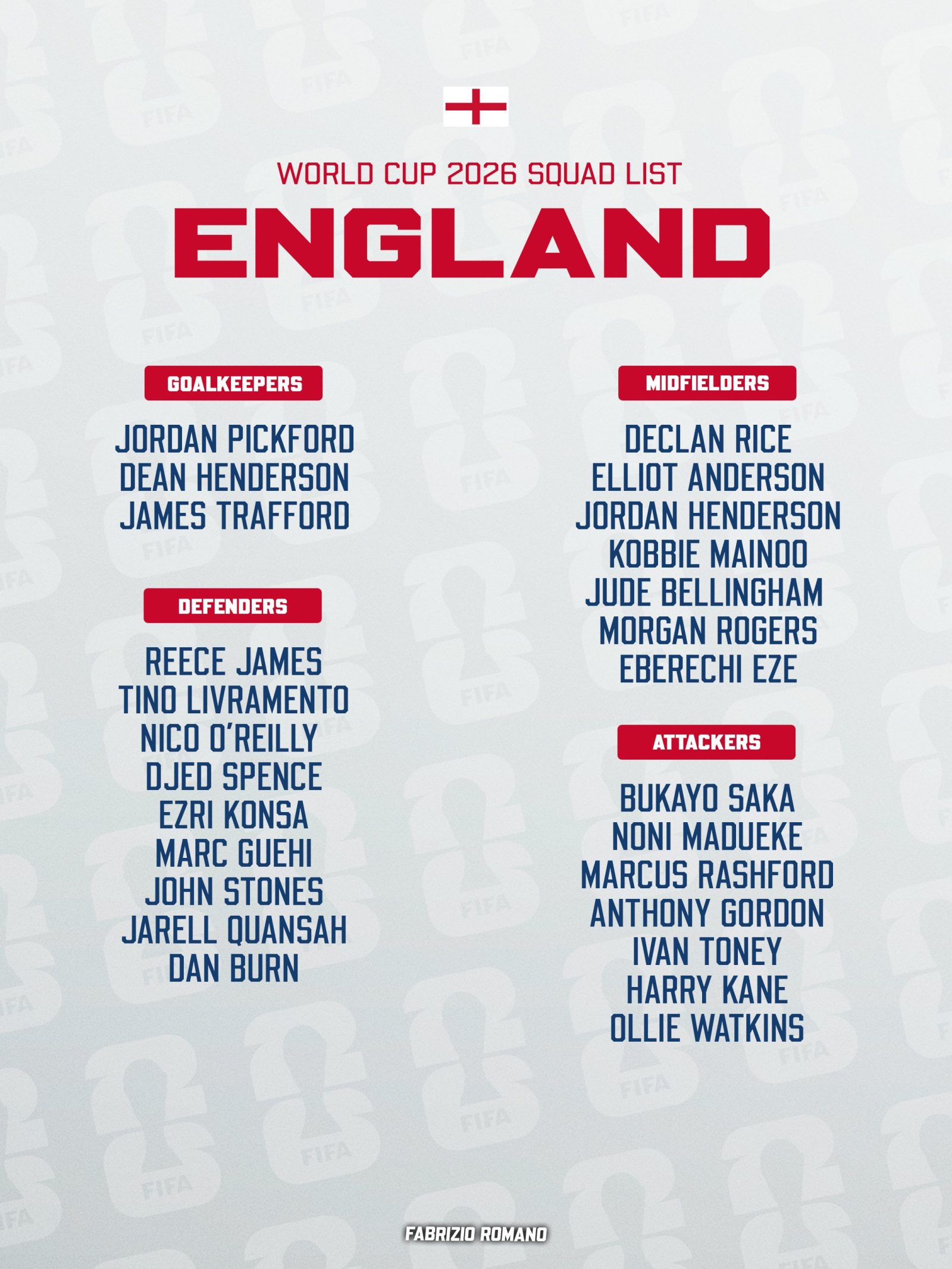
Jordan Pickford remains England’s first-choice goalkeeper, joined by Dean Henderson and James Trafford.
Defensively, England now look younger, faster, and more aggressive with Reece James, Tino Livramento, Nico O’Reilly, Jed Spence, Ezri Konsa, Marc Guéhi, John Stones, Jarell Quansah, and Dan Burn all included.
The midfield is built around Declan Rice and Jude Bellingham, who are expected to become the emotional and tactical leaders of this England side throughout the tournament. Kobbie Mainoo’s inclusion further confirms England’s growing trust in fearless young talent, while Morgan Rogers, Elliot Anderson, Jordan Henderson, and Eberechi Eze bring energy, creativity, and tactical flexibility.
Further forward, England still possess frightening attacking depth.
Harry Kane once again leads the squad as captain, supported by Bukayo Saka, Marcus Rashford, Anthony Gordon, Noni Madueke, Ollie Watkins, and Ivan Toney.
Toney’s inclusion is especially significant after many believed he might miss out, while Watkins’ place rewards another strong season at the highest level. Madueke and Gordon, meanwhile, reflect Tuchel’s desire for direct runners capable of stretching defenses aggressively in transition.
Ultimately, this squad announcement feels less like a standard selection and more like a statement.
Thomas Tuchel as said; ”a lot of factors play into that nomination process. Like I said, I love the difficult decisions, and I love the tough decisions, they bring a certain edge”. as reshaping England entirely before the World Cup even begins.
He has sacrificed reputation for structure, trust for intensity, and familiarity for tactical conviction.
Now comes the difficult part.
Proving these brutal decisions were the right ones.