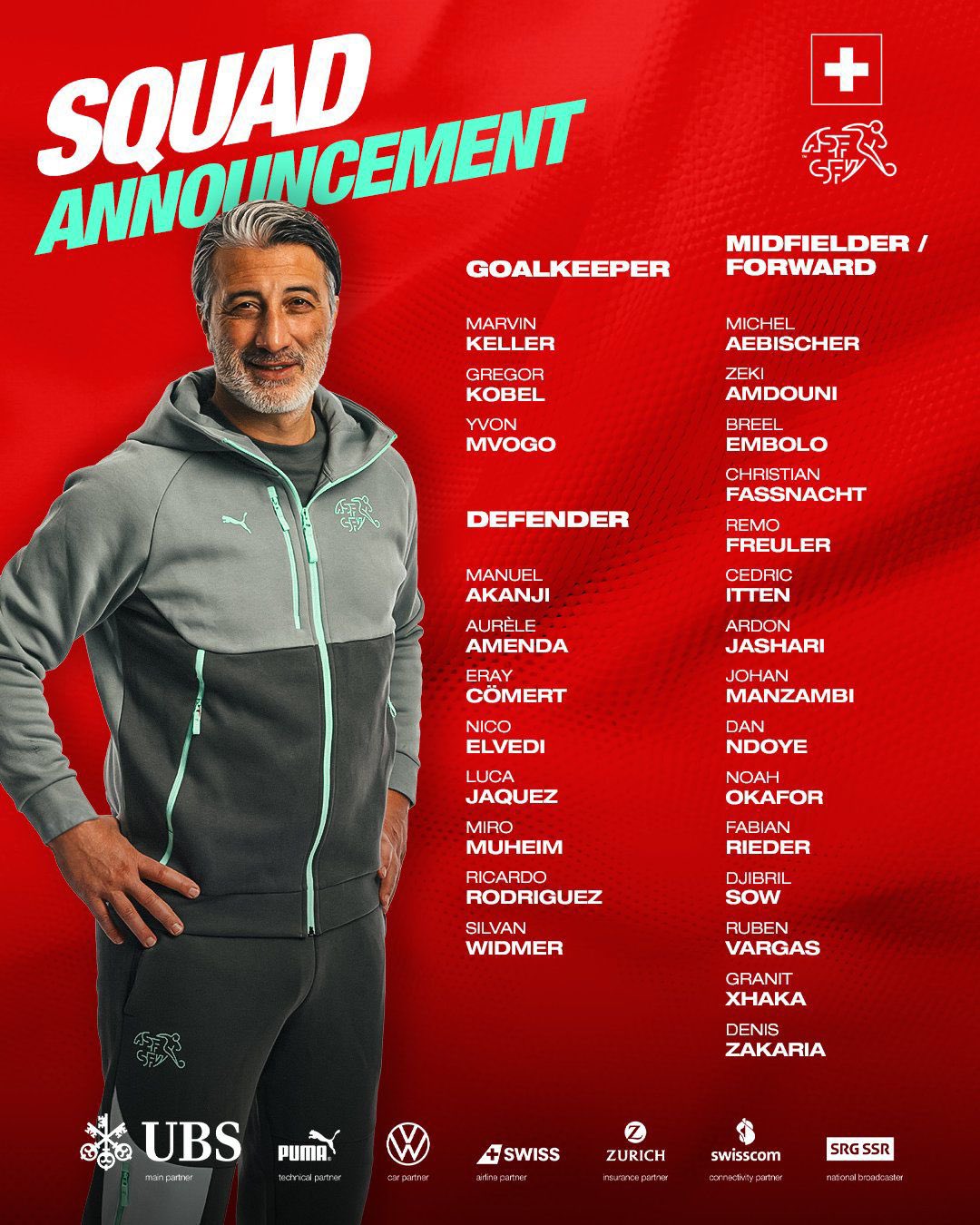
Switzerland may not enter the 2026 FIFA World Cup carrying the same global hype as football’s traditional superpowers, but their newly announced squad suggests they could once again become one of the tournament’s most dangerous outsiders.
Built around discipline, tactical intelligence, physical strength, and a growing wave of emerging talent, Switzerland head into the World Cup with a squad capable of frustrating elite nations and producing another deep tournament run.
And while many teams continue to rely heavily on superstar individuals, Switzerland’s greatest strength may once again be the collective identity that has made them one of international football’s most consistently competitive sides over the last decade.
In goal, Gregor Kobel headlines the selections and is expected to remain Switzerland’s first-choice goalkeeper heading into the tournament. Widely regarded as one of Europe’s most reliable shot-stoppers, Kobel brings calmness, leadership, and elite reflexes to the Swiss backline.
Marvin Keller and Yvon Mvogo complete the goalkeeping department, giving Switzerland solid depth and experience between the posts.
Defensively, the Swiss once again look extremely organized and physically imposing.
Manuel Akanji remains the leader of the backline and one of the most important figures in the entire squad. His composure on the ball, positional awareness, and leadership qualities continue to make him the foundation of Switzerland’s defensive structure.
Alongside him, Nico Elvedi adds experience and tactical discipline, while Aurèle Amenda represents the next generation of Swiss defensive talent. Ricardo Rodríguez and Silvan Widmer once again provide experience and balance in wide areas, with both players expected to play key leadership roles during the tournament.
Young defenders such as Lucas Jaquez and Eric Cömert also highlight Switzerland’s growing defensive depth, while Miran Muhheim offers additional flexibility on the left side.
But it is in midfield where Switzerland may possess their strongest platform for success.
Granit Xhaka enters the tournament as the emotional and tactical heartbeat of the team. The veteran midfielder continues to play some of the best football of his career and remains absolutely crucial to Switzerland’s ability to control matches under pressure.
Alongside Xhaka, Denis Zakaria and Remo Freuler provide physicality, experience, and tactical intelligence in central areas, forming one of the most balanced midfield cores outside the traditional elite nations.
The inclusion of Johan Manzambi, Ardon Jashari, and Fabian Rieder also signals Switzerland’s commitment to integrating younger talents capable of carrying the national team into a new era.
Further forward, Switzerland possess several dangerous attacking profiles capable of causing problems for any defense.
Zeki Amdouni’s creativity and movement continue to make him one of Switzerland’s most important attacking threats, while Noah Okafor brings pace, technical quality, and unpredictability in transition.
Breel Embolo’s inclusion gives Switzerland a powerful focal point in attack, especially with his ability to stretch defenses physically and create space for runners around him. Ruben Vargas and Dan Ndoye add explosiveness in wide areas, while Christian Fassnacht provides additional versatility and work rate.
One of the more intriguing inclusions is Johan Manzambi, whose emergence has generated excitement among Swiss supporters as the federation continues building toward the future.
Unlike some of the tournament favorites, Switzerland are unlikely to dominate headlines heading into the World Cup.
But that may suit them perfectly.
Over recent tournaments, Switzerland have built a reputation as one of the most difficult teams to break down in international football. Their organization, tactical discipline, and mentality have consistently allowed them to compete against technically superior sides.
This latest squad appears to continue that identity while also adding more youth, athleticism, and attacking energy.
The challenge now is whether Switzerland can finally take the next step.
For years, they have been respected competitors capable of producing upsets and difficult knockout matches. But with the experience of Xhaka, Akanji, Rodríguez, and Freuler combined with the emergence of younger talents like Okafor, Jashari, and Amdouni, there is growing belief that this generation may be capable of something even bigger.
They may not arrive as favorites.
But Switzerland once again look like a team nobody will want to face at the 2026 FIFA World Cup.